Florida Statute 119.0701 governing public agency contracts requires that all contracts for services entered into with contractors to the agency contain a clause governing public records and public records requests. That law has been in place since 2013, and it was expanded and given more teeth in 2016.

Yet at least one important contract for services (and probably many more) between the City of Largo (henceforth “Largo”) and a service provider does not comply with that state law. Largo’s contract with JustFOIA, a vendor to the city that provides a platform for management of public records requests, does not contain the language required by the law.
The statutory language required pertains to public records, it must be “in at least 14-point boldfaced type” and should be “in substantially the following form:”
“IF THE CONTRACTOR HAS QUESTIONS REGARDING THE APPLICATION OF CHAPTER 119, FLORIDA STATUTES, TO THE CONTRACTOR’S DUTY TO PROVIDE PUBLIC RECORDS RELATING TO THIS CONTRACT, CONTACT THE CUSTODIAN OF PUBLIC RECORDS AT (telephone number, e-mail address, and mailing address).”
In addition, the important “provision that requires the contractor to comply with public records laws” is also nowhere to be found in Largo’s contract(s) with JustFOIA, which Largo identified as “the current in-force contract between” itself and JustFOIA.
In other words: JustFOIA, a company that has dozens of clients in Florida for its public records management platform, ironically was unaware of Florida statutory requirements involving public records that have to be in its contracts with its customers. Is it merely ironic, or a sign of incompetence?
However, it is Largo (not JustFOIA) that is required to ensure that the specified language is included in the contract. The below table on page 5 of the contract JustFOIA signed with Largo in 2020 provides a clue about how Largo bumbled and stumbled their way into non-compliance with Florida Law.
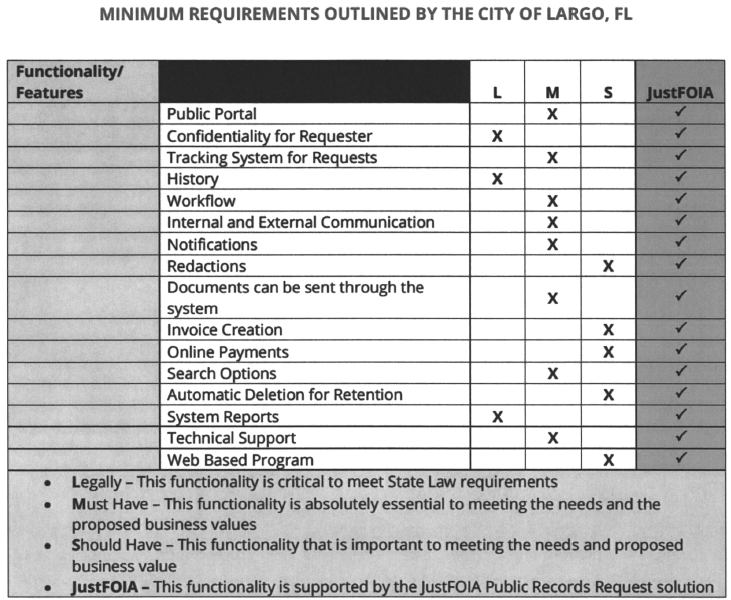
The column titled “L” is defined as “Legally – this functionality is critical to meet State Law requirements.”
If column “L” is indeed “minimum requirements outlined by the City of Largo,” as the document claims, then it shows that Largo was aware of Florida statutory requirements. Largo just didn’t consider Florida Statute 119.0701 to be of “critical” importance.
Or maybe Largo staff and their third-party lawyers just didn’t give a toss about that law?
The absence of the required language matters because JustFOIA has not provided records in response to our Florida public records request, sent to them on December 31st, 2025. JustFOIA has not even acknowledged request of our request, which is something that is also required by Florida law.

Such sloppiness by Largo in matters of Florida law, also causing confusion among its sales-oriented and legally inexpert vendors about what their legal responsibilities are, can result in public records lawsuits. And in such cases, Largo would pay all costs and attorneys fees.
Another troubling aspect of JustFOIA’s platform that is used by so many Florida municipalities is that it binds those requesting public records to “terms of service” and a “privacy policy” that Florida law does not allow. That’s illegal.
The right of any person “to inspect or copy any public record” is enshrined in Section 24 of the Florida Constitution. Nowhere in Section 24, or anywhere else in Florida law, are government agencies allowed to subjecting that right to public records to “terms of service” and a “privacy policy,” which is exactly what JustFOIA does. Such “terms” and “policies” matter because it exposes those requesting public records to having to defend expensive lawsuits from JustFOIA through their indemnification clause.
Attorney Kristin S. Ottinger at BMO Law, the law firm used by Largo, wrote in a review of the matter that “JustFOIA’s relationship to Largo is solely that of an independent contractor and the agreement with the parties does not confer upon or give to any person or entity, other than the parties, any right or remedy under the agreement. To the contrary, the customer (public) terms when accessing uploaded documents through JustFOIA include language related to use of their site, which do not directly involve Largo” [boldfacing added].

In plain English: Largo can NOT impose “terms of service” and a “privacy policy” on requestors of public records because that would be illegal…but if Largo appoints a private company to provide a platform to deliver records, then that company can violate people’s Florida Constitutional right. As agents acting for Largo, that private company can do what it would be unlawful for Largo to do.
One could call it circumvention of constitutional constraints through the use of private actors. Or to be more clear: “Government outsourcing unlawful conduct”…to coin a phrase.
Should our recent article about how a $49,000 fraud was swept under the rug by Largo together with the facts described above give Largo residents reason to question the competence and intentions of Largo staff and agents acting on their behalf?
As always….the Guardian reports and the readers decide. Please like our Facebook page to find out when we publish new stories.